Thursday, 28 January 2016

spaghetti animations

We are in the penultimate week of our Human condition project and an idea has been slowly forming and coming together. I want to juxtapose video, animation and narration to communicate the human condition. I want to use a visual analogy of spaghetti and thread tapestries to communicate life and the human condition. I want to think of another analogy, though so that I can have a power of three. Or at least more footage. I was thinking of incorporating all of the animations I have made (See previous posts)

These animations were made in my room with the strands of spaghetti on top of a scanner. I had to use water to keep the spaghettis slimy and I moved them with tweezers. The Animation above is flipped half way through so that the strand passes through. That's the rough and ready animation style that I like in lots of films. Some animators are very precise and patient and will do everything perfectly but I honestly don't have the dedication for something like that. I never wanted to be an animator because it it takes too long. Yet here I am!

I wanted this animation to feel like little microbes or sperm. I used a lens correction filter to add a subtle chromatic abberation to look like a microscope almost. The black of the scanner could be interpreted as dirt.
 I ping-ponged the animation so that it was 'seamless' also. Animators have always used little looping tricks to maximise efficiency and save time.


Friday, 22 January 2016

Animations I've made so far.


This week at college (3rd from last) I've been producing digital animations relating to our human condition project. The animators that Greg showed us; Robert Breer and Jeff Sher  reminded me of the great ability that animation has to embed information- motion, emotion and subconscious information through the dimension of time.
This first animation I tried to use different brush sizes, colours and opacity to bring a sprinkle of the zest that entirely makes up Jeff Sher's films. This split head seems to have slightly become the symbol of my project to me.


After starting an animation I eventually scrapped, I decided to zoom in and focus on my ear. Disembodied features are somewhat surrealist and I realised a squiggly ear floating in white space is rather abstract. I then tried adding the hair to provide a different kind of animation. Rather than tracing an image like the ear, the hair is a solid movement kind of animation.


 These animations are rotoscoped from a film I took of myself. It was made using photoshop with a layer for the background, a layer for each video frame, layers for the lines and layers for the yellow face. Lots of layers. Our lesson with Greg this day (yesterday) was all about colour relationships and mixing paints. I decided that I needed to try to incorporate and utilise colour to add to m work. Too often I default to Red, Green, Blue, black, white. This has been stretching me in multiple ways.

In the next two weeks I plan on producing more animations. Possibly longer and pushing these techniques I've been trying out. I have a hand drawn animation of the split head rotating in 3D space in my mind.


Monday, 18 January 2016

Animators and 4D

Robert Breer Very free-moving, loose morphing animations using abstracted colour and every-day objects as well as frame-effects and strobing/flashing.


Jeff Scher Rotoscoped animations of people using various mediums; watercolour, ink, collage to add extra depth and dimensions to simple film footage of people doing things. This adds so much more more meaning in a subliminal message technique.

Artist research - Suture Blue

Suture Blue - http://sutureblue.tumblr.com/


I found this person online and thought that they represented the human condition in a way. The rotoscoping of people combined with glitchy abstract footage represents something beyond the physical realm, something in our subconscious; Dreams, imagination, our perceived surroundings.

There’s a void of me.Fuck that.My friend, where do you think you are going?bzzrk X sutureblue

Thursday, 17 December 2015

Rage comic faces

Rage Comics were popular on the internet a few years ago. They are considered a 'meme'; an image or series of images which are shared widely on the internet and then manipulated by others. This repeats over- morphing, evolving and constantly generating more memes and funny pictures for people to share.

These 'rage comics' tend to have been drawn hastily on microsoft paint and all have a similar but not identical visual theme. Rage comics express extreme emotions that we all experience but struggle to actually express because they are so extreme. Take a minute to look at a few of these expressions, I'm sure you can empathise with how each of them feel even though their features are over exaggerated to the point of abstraction.


I used charcoal to sketch these 'rage faces' down. I chose charcoal because it's fast for getting your ideas down and the lines are nice and thick. If I was going to develop these (which I might) I would probably use a printing technique. I could use mono or lino printing but Greg has recommended screen printing them or maybe even animating them (inspired by Jeff Scher).

Screen prints are wonderfully flat and look almost digital. I could try using a bamboo ink pen or a nice long-haired brush and a pot of black sign painter's one shot.
Each of these three materials get a great hard-edged, opaque black line but each would come out differently.

If I did an animation I think that I'd use Microsoft Paint like the originals to make each frame, one by one.

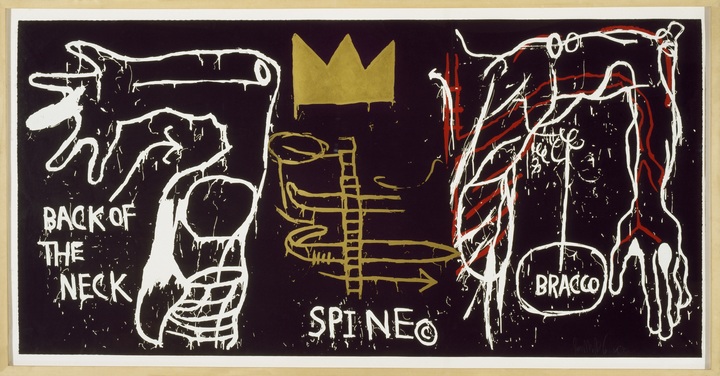
Here are a few examples of screen printing they are by: Shepard Fairey, Andy Warhol and Jean Michael Basquiat. 


Tuesday, 15 December 2015

Artist Research: Jan Švankmajer


Darkness Light Darkness (1990) by Jan Svankmajer (mp4 360p) from Ron Schijfs on Vimeo.


Švankmajer has gained a reputation over several decades for his distinctive use of stop-motion technique, and his ability to make surreal, nightmarish, and yet somehow funny pictures. He continues to make films in Prague.
Švankmajer's trademarks include very exaggerated sounds, often creating a very strange effect in all eating scenes. He often uses fast-motion sequences when people walk or interact. His movies often involve inanimate objects being brought to life through stop-motion. Many of his films also include clay objects in stop-motion, otherwise known as claymation. Food is a favourite subject and medium. Švankmajer also uses pixilation in many of his films, including Food (1992) andConspirators of Pleasure (1996).
Stop-motion features in most of his work, though recently his feature films have included much more live action sequences than animation.
Many of his movies, like the short film Down to the Cellar, are made from a child's perspective, while at the same time often having a truly disturbing and even aggressive nature. In 1972 the communist authorities banned him from making films, and many of his later films were suppressed. He was almost unknown in the West until the early 1980s. Writing in The New York Times, Andrew Johnston praised Svankmajer's artistry, stating "while his films are rife with cultural and scientific allusions, his unusual imagery possesses an accessibility that feels anchored in the shared language of the subconscious, making his films equally rewarding to the culturally hyperliterate and to those who simply enjoy visual stimulation."[3]
Jan Svankmajer - Passionate Dialogue from xenatunda on Vimeo.